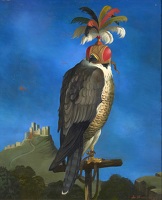
• Monstrol Blue, circa 1935 -
    Send image Biography Sold


    Presentation: Framed
    SN: 178
    Acrylic and oil on canvas, 16 x 22 ins. (40.6 x 56 cms.)
    Provenance: ICI Corporate Collection until 2002

    This painting was commissioned by ICI to commemorate the introduction of the colour monstrol blue by the company in the mid 1930s. The painting is typical of Zinkeisen's pre-war style, balancing successfully her own figurative tendencies and strong sense of design, along with the presiding spirit of Surrealism. The picture dates to the period when Anna, with her sister Doris, painted murals for the liner Queen Mary.
  • All the Colours of the Rainbow, circa 1930 -
    Send image Biography Sold


    Presentation: Framed
    SN: 179
    Signed, oil, en grisaille, 16 x 20 ins. (40.5 x 50.8 cms.)
    Provenance: ICI Corporate Collection until 2002 (commissioned from the artist by ICI 1930)

    This self-portrait, painted in whites and greys, depicts the artist seated as a muse at work. A self-portrait of 1925, exhibited at the Royal Academy, was awarded a Silver Medal. A later self-portrait, dating from 1944, is in the collection of the National Portrait Gallery (NPG 5884).
  • Caledon'  Jade Green, late 1940s -
    Send image Biography Sold


    Presentation: Framed
    SN: 955
    oil on canvas
    16 x 22 in (40.6 x 56cm)

    Provenance: ICI Corporate Art Collection
    Literature: Joyce Watkins, The Studio, 123 (1942), pp 107-111, The Advertiser as Art Patron, ICI Ltd.  Art and Industry, 1950, issue 48 p. 36


    This was one of a number of Zinkeisen paintings commissioned by ICI Ltd in the 1940's as part of their Aspects of Industry series.  Other artists who contributed to the scheme included Cuneo, Pears, Wadsworth, Nevinson and Skeaping and Anna's sister Doris.

    This still life, commissioned  in the late 1940's,  celebrates the invention of a new dye called Caledon Jade Green.  The painting was subsequently used  for an ICI advertisement which, ironically,  was reproduced  in black and white.

    According to the 1950 issue of  Art and Industry,  Caledon Jade Green is especially resistant to laudering and dry-cleaning, besides being little affected by bright sun light.  Its discovery was a major achievement of the British dyestuffs industry, and ranks as one of the worlds's five greatest dyestuffs discoveries of recent years, three of which have been the work of I.C.I chemists, issue 48, p. 36

    we are grateful to Philip Kelleway for his assistance
  • Lady Limerick’s Free Buffet for Soldiers and Sailors, circa 1918 -
    Send image Biography Sold


    Presentation: Framed
    SN: 2585
    Signed and inscribed ‘4 4 0’ on the reverse
    Watercolour on card
    10-5/8 × 14-1/2 in. (27 × 37 cm)
    Provenance: King Street Galleries, 14 June 1984; MichaelWhitehall.

    This picture depicts Lady Limerick’s Free Buffet at London Bridge Station, with the flags of the allies suspended overhead.

    It was Lady Limerick who had the brilliant idea of planning a Free Refreshment Buffet for travelling soldiers and sailors at London’s Bridge Station, and helped to start the Buffet with funds raised on Shamrock Day. Here the travelling soldier or sailor can get a free meal at any hour between 8 a.m. and 10 p. m. – hot tea, coffee, or cocoa, sandwiches, cake, and cigarettes, and for those who are going to the Front letter paper and pencils are provided. An average of 1200 men or more are thus fed per day.The authorities are immensely pleased with this scheme, as the men are kept away from the public-house, and the men also greatly appreciate the interest shown in them by the thirty or forty lady workers (Lady Randolph [Jennie Jerome] Churchill (ed.),Women’sWarWork, C. Arthur Pearson, London, 1916).
Thumbnail panels:
Now Loading